AI Agent Development in 2026: How to Build Autonomous AI Agents for Cloud-Scale Operations
Dec 19, 2025
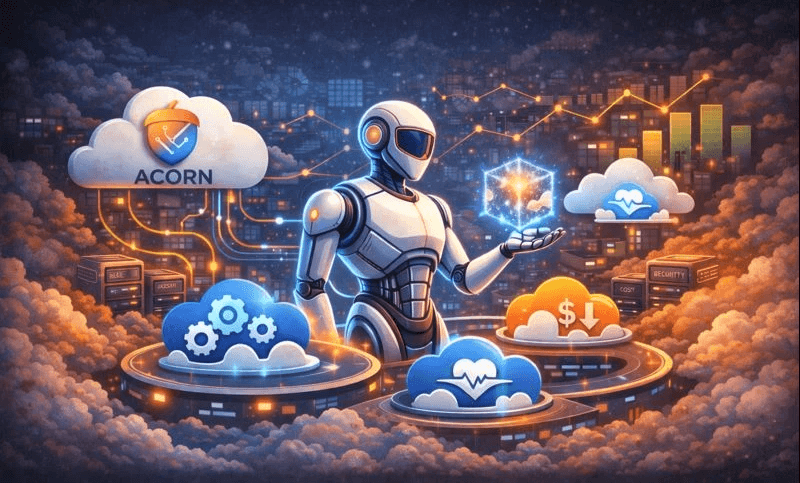
AI has moved beyond chatbots.
While large language models can respond, AI agents can act — autonomously, continuously, and intelligently. In 2026, AI agents are becoming the foundation of cloud operations, compliance enforcement, cost optimization, reliability engineering, and infrastructure monitoring.
At Apton Works, we design and deploy AI agents as part of ACORN — an AI-powered cloud operations platform that helps organizations deploy, secure, optimize, and operate cloud infrastructure automatically.
This guide explains:
What AI agents really are (beyond hype)
How AI agent development works in practice
The architectures that scale in production
Agent types and real-world use cases
How AI agents power modern cloud operations with ACORN
What Is an AI Agent?
An AI agent is an autonomous software system that can:
Understand context
Make decisions based on goals and constraints
Take actions across systems
Learn from outcomes over time
Unlike traditional automation scripts or chat-based AI, agents operate continuously — without waiting for human prompts.
Generative AI responds.
AI agents decide and act.
This distinction is why AI agents are becoming central to cloud operations, security, and infrastructure management.
Why AI Agent Development Matters in 2026
Modern cloud environments are:
Highly distributed
Always changing
Cost-sensitive
Compliance-heavy
Manual operations don’t scale.
According to industry adoption data, most enterprises are already using or actively exploring AI agents — not for novelty, but for operational control and resilience.
At scale, AI agents become:
Cloud operators
Compliance enforcers
Cost governors
Reliability engineers
Monitoring analysts
This is the philosophy behind ACORN.
How to Build an AI Agent: A Production-Ready Framework
Building an AI agent is not about plugging in an LLM.
It requires systems thinking, architecture, and operational discipline.
Step 1: Define the Agent’s Mission & Environment
Start with clarity.
Ask:
What decisions should the agent make?
What systems can it observe?
What actions is it allowed to take?
What constraints must it respect (security, cost, compliance)?
In ACORN, agents are scoped clearly:
Deployment agents provision infrastructure
Compliance agents validate policies
Cost agents optimize resources
Reliability agents prevent outages
Monitoring agents detect anomalies
A well-defined mission prevents unsafe autonomy.
Step 2: Choose the Right Agent Architecture
Enterprise AI agents use different architectures depending on responsibility.
Common patterns include:
Rule-driven agents
For deterministic enforcement (policies, guardrails)Goal-oriented agents
For optimization problems (cost, performance, scaling)Learning agents
For adaptive behavior based on historical outcomesMulti-agent systems
Where specialized agents collaborate under orchestration
ACORN uses multi-agent orchestration, allowing independent agents to coordinate without conflict — a critical requirement in cloud environments.
Step 3: Connect Data, Signals, and Context
AI agents are only as good as the signals they receive.
Typical inputs include:
Infrastructure metrics (CPU, memory, latency)
Logs and events
Cost and billing data
Security and compliance signals
Historical incidents and actions
User and system feedback loops
ACORN agents operate with continuous real-time telemetry, not delayed reports — enabling proactive decision-making.
Step 4: Select the AI & Systems Tech Stack
AI agent development spans multiple layers.
Common stack choices:
Layer | Purpose |
|---|---|
Programming | Python (agent logic, orchestration) |
AI Models | LLMs + task-specific ML models |
Agent Frameworks | State machines, planners, tool-calling layers |
Data Stores | PostgreSQL, time-series DBs, vector stores |
Cloud | AWS, Kubernetes, managed services |
Integrations | APIs, CLIs, infrastructure controllers |
In ACORN, models never operate in isolation — they are always bound by policy, auditability, and safety layers.
Step 5: Implement Decision Logic & Actions
This is where AI agents differ from chatbots.
Agents must:
Evaluate multiple options
Simulate impact (cost, risk, reliability)
Choose the best action
Execute safely
Record outcomes
Example ACORN actions:
Scale infrastructure down when idle
Block non-compliant configurations
Rebalance workloads to reduce cost
Alert before reliability degradation
Auto-remediate known failure patterns
Step 6: Test the Agent Under Real Conditions
Testing AI agents requires more than accuracy checks.
Key validation areas:
Decision correctness
Safety boundaries
Failure handling
Performance under load
Conflict resolution (multi-agent systems)
ACORN agents are tested against real production-like cloud scenarios, not synthetic prompts.
Step 7: Deploy, Observe, and Continuously Improve
AI agents must be monitored — just like infrastructure.
Key operational metrics:
Decision latency
Action success rate
Cost impact
Reliability outcomes
False positives / negatives
ACORN includes agent observability, ensuring every action is explainable, auditable, and reversible.
Real-World AI Agent Use Cases in Cloud Operations
✅ Cloud Deployment Automation
Agents analyze applications and provision production-ready infrastructure automatically.
✅ Compliance & Security Enforcement
Agents continuously validate configurations against security and regulatory policies.
✅ Cloud Cost Optimization
Agents detect waste, right-size resources, and schedule idle environments.
✅ Reliability Engineering
Agents predict failure patterns and trigger preventive actions.
✅ Continuous Monitoring & Alerting
Agents separate noise from real incidents and escalate intelligently.
These are not future concepts — they are operational realities inside ACORN.
Why ACORN Takes a Different Approach to AI Agents
Most AI agent platforms focus on conversation. ACORN focuses on operations.
What makes ACORN different:
AI agents with real execution authority
Built-in compliance and auditability
Cost optimization without reliability trade-offs
Multi-agent coordination by design
Enterprise-grade safety and control
ACORN doesn’t just assist cloud teams — it operates alongside them.
Final Thoughts: AI Agents Are the New Control Plane
In 2026, AI agents are becoming the operating system for cloud infrastructure.
Organizations that succeed will:
Build agents with clear missions
Design for safety and observability
Integrate deeply with cloud operations
Treat autonomy as an engineering discipline
At Apton Works, ACORN represents this future — where AI agents manage cloud complexity so teams can focus on innovation.