Multi-Cloud Strategy in 2026: Challenges, Best Practices, and How to Make Cloud Flexibility Work
Dec 23, 2025
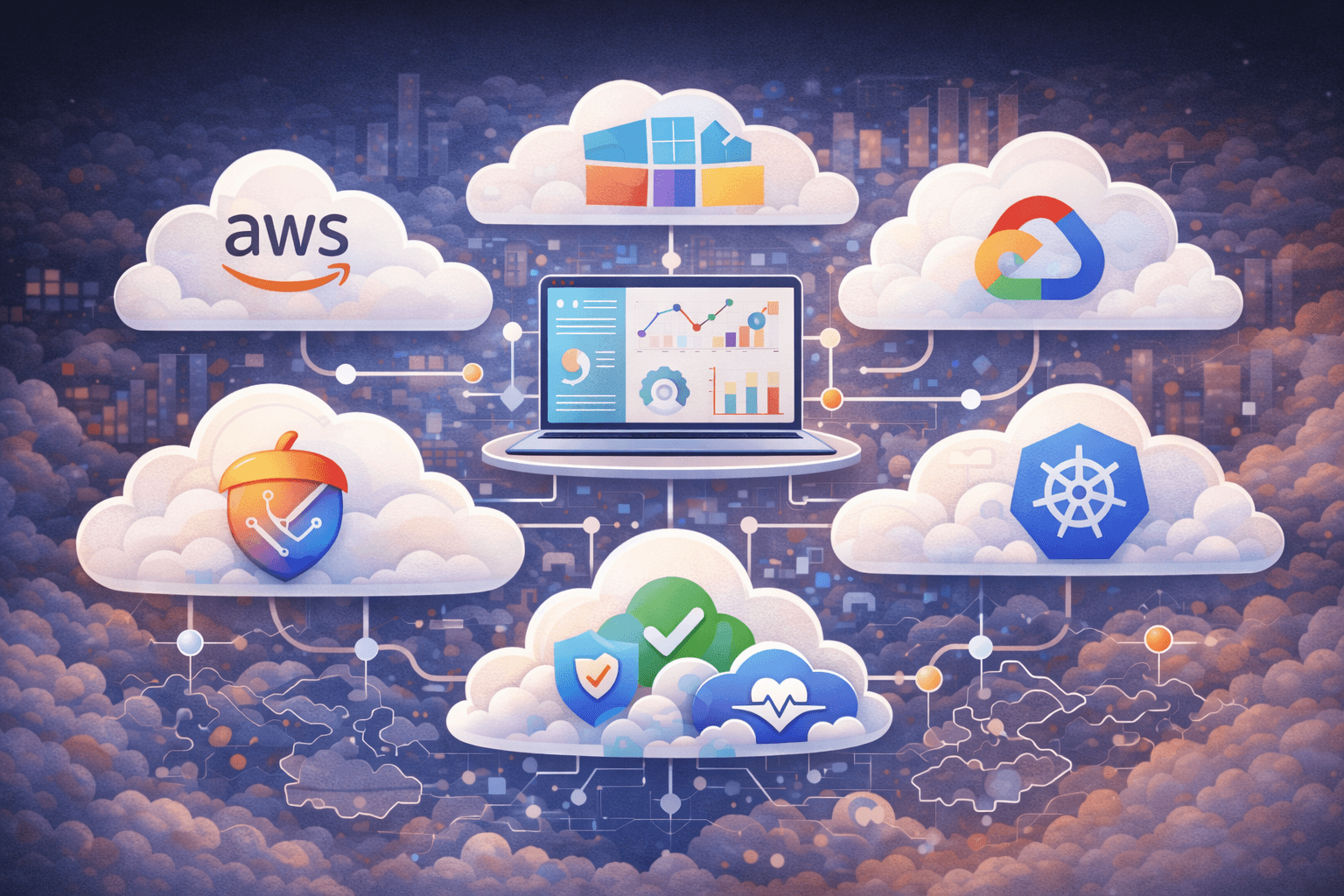
Multi-cloud has become a strategic priority for modern enterprises. Organizations adopt multiple cloud providers to reduce vendor lock-in, improve resilience, optimize costs, and access best-in-class services.
However, without the right operational foundation, multi-cloud often increases complexity, cost, and risk instead of reducing them.
At Apton Works, we help organizations design and operate multi-cloud environments using ACORN — an AI-powered platform for cloud deployment, compliance, cost optimization, reliability, networking, and monitoring.
This guide explains what multi-cloud really means, why organizations adopt it, the challenges teams face, and the best practices to make cloud flexibility work in real-world production environments.
What Is a Multi-Cloud Architecture?
A multi-cloud architecture is an approach where applications, data, and workloads run across two or more cloud providers simultaneously. This often includes a combination of public clouds such as AWS, Azure, and Google Cloud, along with private or on-prem environments.
Multi-cloud can exist at multiple layers.
Data Layer
Data is shared or replicated across cloud providers so workloads can access it regardless of where they run.
Service Layer
Services from one cloud are consumed by applications running in another cloud, enabling teams to use best-in-class services without full platform migration.
Workload Layer
Applications are distributed across multiple clouds using portable execution models such as containers and Kubernetes.
In Kubernetes-driven environments, multi-cloud increasingly means operating clusters across providers using a unified control model, where the underlying cloud becomes an implementation detail.
Why Organizations Adopt Multi-Cloud
Cost Optimization Through Choice
Different cloud providers price compute, storage, and networking differently by region and service type. Multi-cloud enables teams to compare pricing dynamically, place workloads where they are most cost-efficient, and avoid long-term dependency on a single vendor.
Cost benefits only materialize when visibility and optimization are centralized across environments.
Access to Best-in-Class Services
No single cloud provider is best at everything. Multi-cloud allows teams to combine strengths, such as running core infrastructure on one cloud while leveraging advanced analytics or AI services from another.
This flexibility delivers value only when integrations, networking, and governance are designed correctly.
Performance and Scalability
Multi-cloud enables geographic optimization and capacity flexibility. Workloads can be deployed closer to users, scaled in regions with available capacity, and shifted when demand spikes.
Without automation, these decisions become slow and risky.
Resilience and Business Continuity
Cloud outages are inevitable. A well-designed multi-cloud setup reduces single-provider dependency and enables failover across clouds, improving overall system resilience without duplicating infrastructure within a single provider.
Security and Compliance Flexibility
Different cloud providers offer different compliance certifications and regional guarantees. Multi-cloud allows organizations to meet regulatory requirements while selecting platforms that best align with industry needs.
The challenge is enforcing consistent security policies across all environments.
The Real Challenges of Multi-Cloud
Operational Complexity
Each cloud provider has its own APIs, IAM models, networking constructs, and billing systems. Managing these differences increases operational overhead and slows incident response.
Security and Compliance Risks
Multi-cloud increases the attack surface. Without centralized governance, security policies drift, compliance violations go unnoticed, and audits become manual and error-prone.
Cost Visibility and Financial Control
Each cloud provider uses different pricing models and billing formats. Without a unified view of spend, teams overprovision resources and miss optimization opportunities.
Networking and Data Transfer Complexity
Inter-cloud communication introduces latency, data egress fees, and architectural complexity. Poor networking design can eliminate the cost and performance benefits of multi-cloud.
Tool and Vendor Fragmentation
Each cloud platform provides its own monitoring, logging, and automation tools. This fragmentation reduces engineer productivity and increases mean time to resolution during incidents.
Best Practices for Building a Sustainable Multi-Cloud Strategy
Standardize Architecture and Deployments
Standardization is foundational. Infrastructure as Code (IaC) enables repeatable, version-controlled environments across providers, reducing configuration drift and simplifying migration.
Centralize Monitoring, Security, and Governance
Multi-cloud requires centralized visibility. Unified monitoring, consistent identity management, and policy-driven security enforcement are critical for operational stability and audit readiness.
Optimize Networking and Data Placement
To reduce latency and cost, co-locate compute and data where possible, use cloud-agnostic APIs, and design resilient inter-cloud connectivity.
Automate Everything That Scales
Manual operations do not scale in multi-cloud environments. Automation should cover scaling, cost optimization, compliance validation, and failure remediation.
Use Kubernetes for Portability — and Enhance It with Intelligence
Kubernetes provides workload portability and consistent deployment models across clouds. However, Kubernetes alone does not solve cost optimization, autoscaling conflicts, or governance challenges.
ACORN augments Kubernetes with AI-driven optimization, compliance enforcement, reliability engineering, and centralized monitoring.
How ACORN Makes Multi-Cloud Work in Practice
ACORN is designed for organizations operating across multiple clouds and environments.
With ACORN:
Workloads are continuously optimized for cost and performance
Compliance policies are enforced consistently across providers
Networking and observability are centralized
Reliability risks are detected and mitigated early
Instead of managing clouds individually, teams operate one intelligent, unified cloud platform.
Final Thoughts
Multi-cloud is not a silver bullet. It is a strategic capability that requires strong architectural discipline, automation, and centralized governance.
When designed correctly, multi-cloud delivers flexibility, resilience, cost efficiency, and vendor independence. When designed poorly, it introduces complexity, hidden costs, and security risks.
The difference lies in standardization, automation, and intelligent cloud operations.
At Apton Works, ACORN enables organizations to turn multi-cloud from an operational challenge into a sustainable competitive advantage.